Friday, January 27, 2012

REVIEW: THE BLACKHOPE ENIGMA by Teresa Flavin

This was another young adult (I'd place this in the 9-13 year old age range) title that made its way into my review pile.  Something about its description, and yes, its cover, kept tempting me.  

It centers around a group of young teens who are assigned to do a historical art project.  Two of the class pick the same Renaissance artist, il Corvo,  and are studying his work at Blackhope Tower when the adventure begins.  The heroine's step-brother accidentally finds the secret to the labyrinth mosaic and ends up inside the painting.  Sunni goes in after him, along with her classmate, followed closely by an art historian.  The group encounters enchanted mazes, hidden layers, puzzles, maps and coded languages.  They must find a way out of the painting, and protect il Corvo's secret.  

It's fairly adventurous, with plenty of captures and escapes.  But there is no gore or intense violence so it is still age appropriate.  The characters learn and discuss a great deal about art and therefore impart a great deal on to the reader.  One will learn about underpainting, sketches, murals, chiaroscuro, and other techniques. 

On the other hand, some of the "intrigue" is a bit convoluted.  Crosses, double-crossed, disappearances, etc. almost need a scorecard to keep track of, and some don't have a clear motive.  I wondered if it might be difficult for a young person to follow. 

It's certainly a much better book for young people to read than most of the vampire tripe out there.  At least with this title they can see characters which determination, spunk and intelligence. 

 Many thanks to the folks at Candlewick Press for the review copy.
___________________________
ISBN-10 / ISBN-13: 0763656941 / 9780763656942
on sale date: 08/2011
type/format: Hard Cover
# of pages/size: 304 / 5 1/8" x 7 5/8"
Wednesday, January 25, 2012

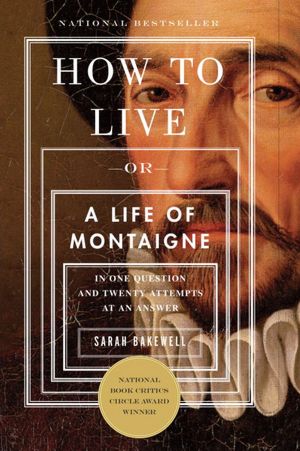
REVIEW: HOW TO LIVE, OR, THE LIFE OF MONTAIGNE by Sarah Bakewell


I must say, I prefer biographies of this sort.  It's far too arrogant for a biographer to think they can just begin at the beginning and go from there.  Bakewell instead takes a more meaningful approach to a thinker, philosopher, and writer four-hundred years and a language removed.  She drops in, like a neighbor stops in for a chat.  Each chapter approaches the question (his won quest), "How to Live?"  with an answer buried in Montaigne's own writing.  Bakewell then expands up this idea by highlighting a trait or era in Montaigne's life.  

Michel Eyquem de Montaigne was born in 1533.  In 1570, he "dies" when thrown from a horse -- or so was thought.  He pulls through and the experience changes him forever.  He begins to look at life from outside of himself, and thus understand himself better.  His stream of consciousness essays are the earliest of their kind.  In French, the word essayer means "to try."  In each of his essays, Montaigne tried out different ideas, trains of thought.  

Montaigne's Chateau
Of course, it may not seem that difficult to be introspective with a house like that and an entire tower as a library.  But Montaigne was also a public servant and a working landowner.  It seems, based on his papers, he took his position in society very seriously and subscribed to noblese oblige.

This book is an excellent introduction to Montaigne, especially since his writings can be a bit overwhelming at first.  It should also be a boon for Monataigne enthusiasts.  Bakewell sheds light on this influential thinker, places him among the ranks of Aristotle, and Descartes, while at the same time humanizing him.  With this book, she proves that philosophy doesn't have to be boring, dusty or out of reach. 

Many thanks to the folks at Other Press for the review copy.
________________________________________

Released October 19, 2010 | Hardcover | 400 pages | ISBN: 978-1-59051-425-2

Wednesday, January 18, 2012

REVIEW: THE DOLL by Daphne du Maurier

The Lost Short Stories

These tales written very early in her career (1926-1932), long before Rebecca.  Some were published much later, some not at all.  It's fascinating to see the writer she would become taking shape in these early stories.  Sometimes they style is slightly more simplistic as though they were first drafts or rough sketches.  What always comes through, however, is her exploration of the human psyche -- both of her characters and the reader.  She reveals only just so much, leaving the reader to fill in the blanks.  But rest assured, we land just where du Maurier leads us.  Somehow we now the darkened path, the frightening staircase will lead us down but we can't stop reading.

du Maurier on the stairs of her beloved home, Menabilly
Another theme that du Maurier employs in her stories that transfers to the reader is a sense of emptiness. The Doll tracks the slow descent to madness through "found" pages of a diary.  A man chases an elusive woman, named Rebecca (naturally).  She is described as cold, heartless vacant.  To the narrator she is a doll.  Perfection is in construction but absent of feeling or soul.  But Rebecca's fickle nature drives the narrator mad.  And Now To God The Father displays her distinct distrust of organized religion.  Frustration reads like a novice's attempt at an O. Henry ironic fable.  Tame Cat is entirely unsettling just like we expect du Maurier should be.  By writing from the point-of-view of an incredibly naive narrator, the reader is able to withhold judgement until the awful truth cannot be denied.  Nothing Hurts For Long are the interior thoughts of a two-faced, fair weather "friend."  Weekend is bitingly realistic and darkly funny.  Within a few short pages, she has traced the evolution of a relationship, albeit cynically.

All of the stories poke at our idea of normal, challenging what is comfortable.  This is unsurprising, knowing the little we do about her unconventional upbringing.  Her grandfather was George du Maurier, author of the wildly popular Trilby.  Daphne was also cousin to the Llewelyn Davies boys, who ultimately inspired J. M. Barrie to write Peter Pan.  Psychologically unnerving and yet somehow of a parallel universe, The Doll will resonate with fans of Jamaica Inn, Don't Look Now (aka Not After Midnight), Rebecca, and The Scapegoat.  

Also read a great article in The Telegraph.

Many thanks to the folks at William Morrow / HarperCollins for the review copy.
____________________________

ISBN: 9780062080349
Imprint: William Morrow Paperbacks
On Sale: 11/22/2011
Format: Trade PB
Trimsize: 5 5/16 x 8
Pages: 224; $14.99
Ages: 18 and Up